How to Brew Green Tea — Without Ruining It
Green tea has acquired a slightly unfair reputation.
“I've tried green tea. It was horribly bitter.”
We hear variations on this surprisingly often.
Sometimes, of course, somebody simply doesn't like green tea. That's perfectly reasonable. But very often the culprit isn't the tea at all.
It's the way it was made.
Pour freshly boiling water over a delicate Japanese Sencha, leave it sitting there for five minutes while you answer the telephone, and you have given even a very good tea quite a challenge.
Green tea generally asks for a little more care than a traditional British black tea.
Not ceremony.
Not specialist qualifications.
Just cooler water, a shorter infusion and a willingness to taste what is happening in the cup.
Get those things right and what seemed bitter and rather worthy can suddenly become sweet, fresh, creamy, floral, nutty, grassy, fruity or wonderfully savoury.
First of all: green tea isn't one thing
One of the difficulties with brewing instructions is that we talk about green tea as though it were a single style.
It isn't.
China and Japan alone produce an extraordinary variety.
A Japanese Sencha is normally steamed soon after picking. Our Sencha Fukujyu, for example, has the fresh, grassy and sweet character associated with that style.
A traditional Chinese Long Jing — Dragon Well — is worked by hand in a hot wok, giving its famous flat leaf and a completely different combination of fragrance and sweet, gently roasted character.
Then there is Gyokuro: shaded before harvest to encourage its extraordinary sweet, rich, umami-laden character.
Gunpowder is rolled tightly into little pellets and produces a stronger, more robust infusion.
Genmai Cha combines green tea with roasted rice.
Hojicha starts life as green tea but is roasted until it becomes nutty, toasted and almost caramel-like.
They are all broadly called green tea.
It would be rather surprising if they all wanted exactly the same treatment.
The golden rule: don't automatically reach for boiling water
This is the single most useful change most people can make.
Our green teas generally sit somewhere between 60–90°C, depending on the type of tea.
A very delicate Japanese green tea may want considerably gentler treatment than a robust Chinese Gunpowder, for example.
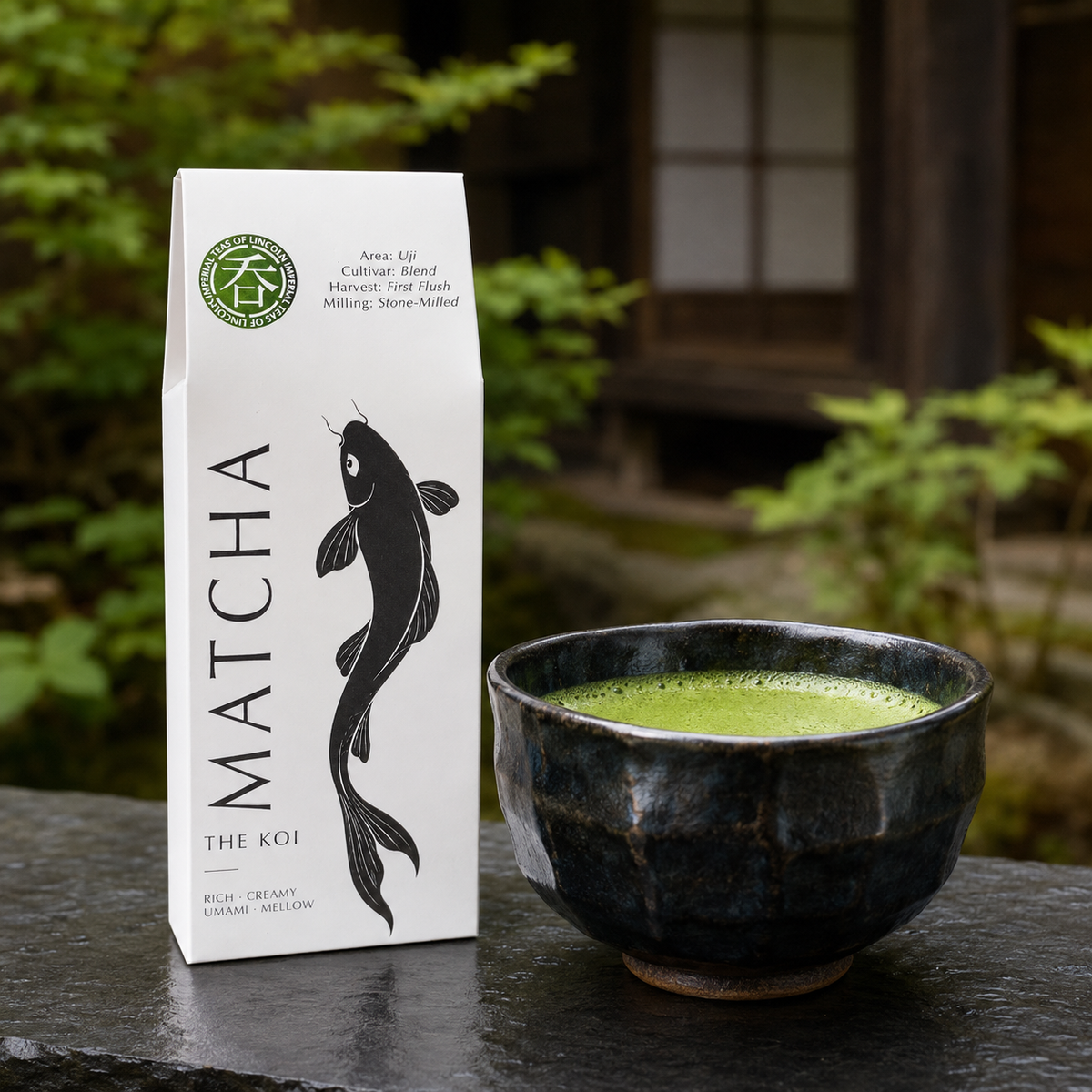
That is why we give a specific brewing temperature on the box for each tea.
Why does it matter?
Because hotter water extracts things from tea more aggressively.
That can be useful with a big black tea you're planning to drink with milk. With a delicate green tea it can quickly bring too much bitterness and astringency into the cup and obscure the sweetness and aroma you bought the tea for in the first place.
Think of temperature as a control rather than a rule.
If the tea tastes hard, bitter or coarse, cool the water down.
You may be astonished by what appears underneath.
But don't become frightened of hot water either
Tea advice has a habit of becoming dogma.
You'll occasionally hear that green tea must always be brewed at one particular temperature.
It isn't as simple as that.
Some green teas are extremely delicate, while others are much more robust and positively benefit from hotter water.
Across our range, the recommended temperature falls somewhere between 60 and 85°c depending on the individual tea.
So rather than remembering one temperature for every green tea, remember this:
The more delicate the tea, the gentler I would begin.
And use the brewing guide on the box as your starting point. We give each tea its own recommendation because we have actually tasted it.
Don't brew it to death
Temperature is only half the story.
The other common mistake is time.
Many green teas need only a relatively short infusion.
That's it.
A good Sencha can release an astonishing amount of flavour remarkably quickly. Leaving it for four or five minutes doesn't necessarily give you more of the flavours you wanted. It can simply extract more bitterness.
Again, tasting solves the problem.
Start with the brewing time on the box.
Pour it.
Taste it.
If you want more strength next time, you can use slightly more leaf or extend the infusion.
It is much easier to add thirty seconds than to persuade bitterness to climb back into the teapot.
Stronger tea? Try more leaf rather than more punishment
This is something I think is particularly useful.
If you like your tea with plenty of flavour, the instinct can be to leave the leaves brewing indefinitely.
Often it is better to use a little more tea and keep the infusion controlled.
You get intensity from the leaf while retaining more of its fragrance, sweetness and freshness.
How much leaf you need depends enormously on the tea. A teaspoon of tightly rolled Gunpowder and a teaspoon of enormous Taiping Houkui leaves clearly aren't the same quantity.
So don't become too obsessed with teaspoons.
After a couple of brews you'll very quickly learn what looks right for your pot or cup.
Leave the leaves some room
This particularly matters with whole-leaf tea.
Dry leaves can be deceptive.
Gunpowder begins as tiny pellets and unfurls into surprisingly large leaves. Taiping Houkui has enormous, spectacular leaves before you've even put it in water.
Squashing good leaf into a tiny infuser doesn't give it much opportunity to open.
A basket infuser, roomy pot or gaiwan allows water to circulate around the leaf and lets you see what the tea is doing.
There is also something rather beautiful about watching good green tea open.
Particularly if someone else is doing the washing-up.

Make it again
Don't automatically throw the leaves away after the first cup.
Many of our better green teas will happily make two or three infusions.
The second infusion isn't necessarily a weaker copy of the first.
It can taste different.
Leaves which have now fully opened release their flavour differently, and sweetness or other characteristics can become more obvious.
You can usually experiment with a slightly different brewing time on subsequent infusions.
This is one of the great pleasures of good loose-leaf tea — and it also makes an expensive tea rather less expensive when you consider how many cups the leaves can produce.
Japanese green tea: fresh, sweet and umami-rich
As a broad guide, Japanese green tea rewards particularly careful brewing.
Sencha can deliver fresh grass, flowers, citrus, melon, creaminess and that wonderful savoury-sweet quality generally described as umami.
Our Kagoshima Yutaka Midori, for instance, has produced tasting notes from our customers ranging from green muscat and melon to flowers, cream and fresh greens.
Those are delicate things.
You don't want to boil them into submission.
For Japanese green teas, use the temperature and brewing-time guide on the box as your starting point and adjust from there according to taste.
Chinese green tea can be quite different
Many Chinese green teas are heated in pans rather than steamed, producing a very different style.
Long Jing is one of the great examples.
The leaves are painstakingly worked in a hot wok and develop that wonderful combination of sweetness, fragrance and subtle roasted character.
At the other end of the spectrum, tightly rolled Gunpowder is altogether more robust. It has a slight smokiness and can cope with rather more assertive brewing.
The lesson again is simply not to treat “green” as the brewing instruction.
The recommended temperature will vary considerably from one tea to another, so use the guide on the box.
What about Genmai Cha and Hojicha?
These are wonderful teas for people who think they don't like green tea.
Genmai Cha combines green tea with roasted rice, creating a mild infusion with sweet, nutty and caramel-like flavours.
Hojicha has been roasted, which transforms the familiar fresh green character into something smooth, toasted, nutty and gently caramel-like.
They are also a useful demonstration of why one temperature cannot sensibly cover every green tea.
Again, use the individual brewing guide on the box for the tea you have chosen.
Do I add milk?
Generally, no.
Our green teas are selected and brewed to show their own fragrance, sweetness, freshness and texture, and milk would tend to cover much of that.
But I'm equally reluctant to turn tea drinking into a collection of commandments.
Before adding anything, taste the tea as it is supposed to be brewed.
Give it that chance.
You may discover that a tea you previously thought needed something added to soften it simply needed cooler water.
And if it's bitter?
Before deciding you don't like the tea, try this:
Lower the temperature. Shorten the brewing time.
If it then feels too weak, add a little more leaf.
That simple sequence solves an enormous number of disappointing cups of green tea.
And change only one thing at a time, otherwise you'll have no idea which adjustment worked.
Our starting guide
There isn't one universal temperature for green tea.
Across our range, the correct starting point sits somewhere between 60 and 90°C, depending on the type of tea, how it was made and the character we want to bring out of the leaf.
That is why every Imperial Teas box carries a brewing guide for the individual tea.
Use that temperature and brewing time first.
Then taste.
If you want to experiment, make small adjustments from there.
The instructions are a starting point, not a sacred text.
The best brewing equipment you own is your palate
There are some beautiful pieces of tea equipment — and we've managed to sell quite a few of them over the years.
But the most useful tool is still taste.
If you enjoy the cup, you've brewed it well.
If you don't, change something.
A little cooler.
A little shorter.
A little more leaf.
Tea is remarkably good at telling you what it wants if you pay attention.
And when a fine green tea is brewed well, the difference can be extraordinary: sweetness instead of harshness, fragrance instead of bitterness, and layers of flavour you might never have suspected were sitting inside those rather unassuming leaves.
So if your previous experience of green tea has been a bitter one, perhaps give it another chance.
This time, don't boil it.